
🔍 Coming into force: The EU Entry/Exit System (EES)
From 12 October 2025, a major change is rolling out at the external borders of 29 European countries: the Entry/Exit System (EES). This is more than just a small procedure tweak — it is a modernisation of how the EU manages short stays, border crossings, security checks, and data. Here’s a clear breakdown of what EES means for non-EU nationals, authorities, and all travelers.
📘 What is EES?
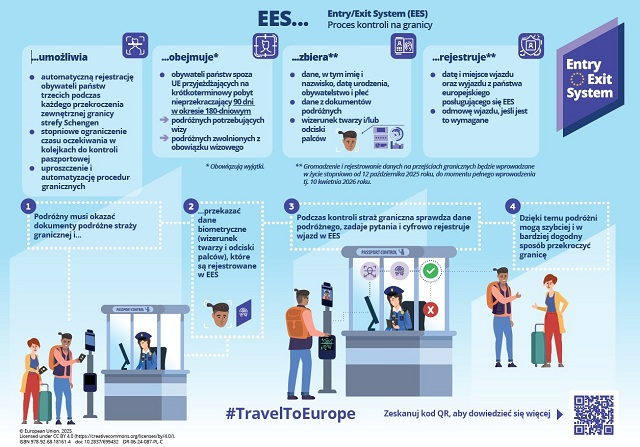
The Entry/Exit System (EES) is a new electronic system designed to register non-EU nationals each time they enter or leave the EU’s external borders for short stays (i.e. up to 90 days in any 180-day period). Whether you need a visa or can travel visa-free, the EES will apply. It also records refusals of entry.
Key collected data include:
- personal data from your travel document (name, date of birth, nationality);
- date & place of each entry and exit;
- bio-metric data, namely facial image and/or fingerprints
🛫 Who is covered, who is exempt?
Covered:
- All non-EU citizens entering one or more of the 29 states using EES, for short stays (≤90 days / 180-day period).
- Regardless of visa or visa-free travel status.
The EES does not apply to:
- Nationals of the European countries using the EES, as well as Cyprus and Ireland
- Non-EU nationals who hold a residence card and are immediately related to an EU national
- Non-EU nationals who hold a residence card or a residence permit and are immediately related to a non-EU national who can travel throughout Europe like an EU citizen
- Non-EU nationals travelling to Europe as part of an intra-corporate transfer or for the purposes of research, studies, training, voluntary service, pupil exchange schemes or educational projects and au-pairing
- Holders of residence permits and long-stay visas
- Nationals of Andorra, Monaco and San Marino and holders of a passport issued by the Vatican City State or the Holy See
- People exempt from border checks or who have been granted certain privileges with respect to border checks (such as heads of state, accredited diplomats, cross-border workers, etc.). Diplomats travelling on short stay may be exempt from EES registration under certain conditions.
- The exception from registration in the EES apply to members of the armed forces travelling on NATO or Partnership for Peace business, who hold an identification and individual or collective movement order provided for by the Agreement between the parties to the North Atlantic Treaty regarding the Status of their Forces and may apply to civilian component or dependents referred to in the NATO Status of Forces Agreement.
- People not required to cross external borders solely at border crossing points and during fixed opening hours
- People holding a valid local border traffic permit
- Crew members of passenger and goods trains on international connecting journeys
- People holding a valid Facilitated Rail Transit Document or valid Facilitated Transit Document, provided they travel by train and do not disembark anywhere within the territory of an EU Member State
Legal base: Article 2(3) of Regulation(EU) 2017/2226
🗓 When & how is it being introduced?
- Start date: 12 October 2025.
- Transition/roll-out period: Over about six months, with gradual deployment across all external border crossings. Some crossings will begin using the system later in that period.
- Once fully in place, all relevant external border points will use EES.
🔐 Why is this being done?
The EU intends EES to:
- Modernise border control; speed up checks and reduce waiting times at border crossings.
- Better track overstays, ensure compliance with visa / short-stay rules.
- Increase security across the EU by making it easier to spot those who do not meet entry or stay conditions.
🧾 Privacy, data protection, and who has access
- The data collected under EES will be handled following EU rules on data protection. Travelers will have rights: to access their data, to request corrections or erasures under certain conditions.
- Access is limited to authorised border, immigration, visa authorities, law enforcement; Europol, and under strict conditions, possibly shared with other states or international organisations.
⚠️ What travelers should do now to prepare
- Check whether you are covered by EES or eligible for an exemption. If you think you might be exempt under one of the listed categories, prepare documentation.
- Ensure your travel documents are valid and in order (passport, visa if required). Bio-metric data will be taken, so anticipate that.
- Allow a little more time at border crossings, especially during the early roll-out. Some border posts may not immediately have full capacity.
- Keep up-to-date with announcements from your destination country/border authorities — each country may have its own “facilitation programs” to speed up processes for frequent travelers.
🗣 Why this matters beyond travel
- For immigration, policy, and legal professionals: EES creates new obligations, compliance needs, and possibly new types of challenges (e.g. appeals, data errors, overstays).
- For businesses and frequent travelers: Passengers, service providers (airlines, carriers) will need to adapt to new verification/bio-metrics procedures.
- For security and border management: EES is a step in using digital tools for managing flows, but also introduces questions about data security, fairness, and transparency.
✅ In short
The EES is intended to make border crossings smoother, safer, and more consistent across the EU. If you’re a non-EU citizen travelling to Europe for short stays (up to 90 days), from 12 October 2025 you’ll almost certainly be a part of EES — unless you meet one of the listed exemptions. Preparing in advance will help you avoid surprises.
We will also discuss the upcoming ETIAS system due in 2026 in a follow-up article.
Links and other sources:StrazgranicznaEES , Komenda Główna Straży Granicznej , EuropaEES / ETIAS – European Union
Useful tools:
EuropaShort-stay calculator – Calculator of travel days remaining under a Schengen short-stay visa